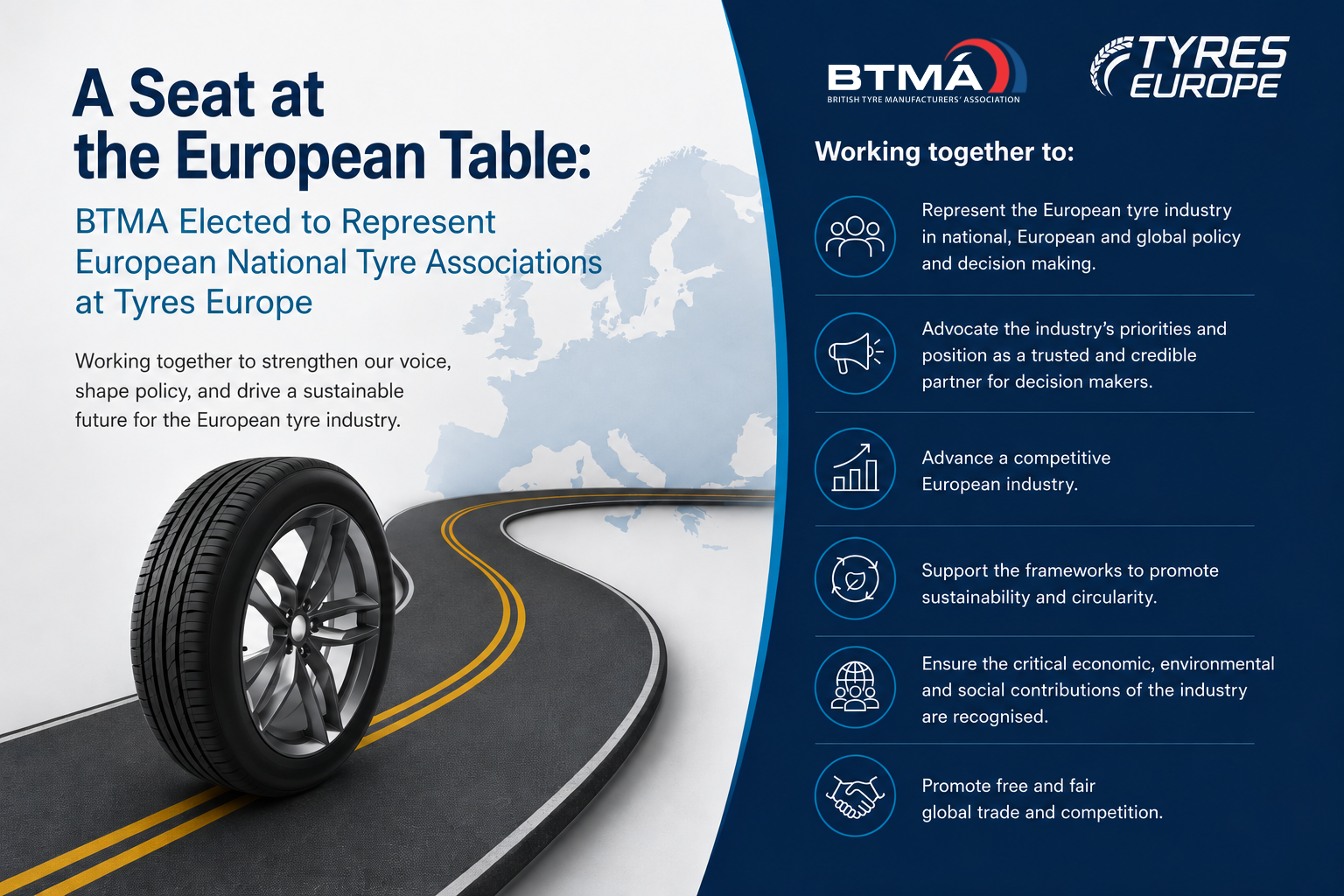
BTMA NEWSLETTER | EUROPEAN AFFAIRS Tyres Europe has established a National Associations Leadership Council, giving…

Retreads and the Race to the Bottom
There was a time, not so very long ago, when Made in Britain signified quality, durability, and a certain no-nonsense approach to getting things right. The tyre industry was no exception. We invested in infrastructure, we trained people, and we built businesses that measured success in decades rather than quarterly reports.
Today, I watch that legacy slowly suffocate under the weight of economic decisions and market forces that seem almost designed to punish domestic competence. The remanufacturing sector, once a quiet and dignified corner of British industry, now finds itself caught in a three-way collision between economic reality, environmental common sense, and what can only be described as a race to the bottom.
Whilst the UK remanufacturing market remains broadly stable, what is decidedly unstable is our ability to compete with facilities operating under an entirely different set of rules. When your competitor is manufacturing in an environment where labour costs are a fraction of yours, environmental regulations are treated more as guidance than obligation, and quality control appears to be optional, the playing field is not so much tilted as it is vertical.
Vaculug operates at the sharp end of this reality. We are Europe’s largest independent tyre retreader, and we remain fiercely proud of that position. Yet pride does not pay the bills when the market is being systematically flooded with cheap imports that would, frankly, give any conscientious safety inspector sleepless nights.
The phenomenon that concerns me most is the arrival of low-cost, single-life tyres. These are products that would struggle to meet the standards we demand of ourselves, yet they are finding their way onto British roads with increasing regularity. The impact is already measurable. Across Europe, demand for retreaded tyres has fallen by 22 per cent since 2021, contributing to an overall market share decline of around 30 per cent over the past decade, driven largely by imports of inexpensive single-life tyres from low-cost manufacturing countries.
From a fleet operator’s perspective, the decision is understandable. Why buy a premium British retread when you can buy a brand-new single-life tyre for less?
The irony is that a properly retreaded tyre is superior in almost every way that actually matters. It delivers outstanding performance, excellent longevity and produces less than half the carbon emissions of manufacturing a new tyre. Yet we’ve somehow engineered a market where the environmentally responsible option is often the more expensive one.
That isn’t progress. It’s policy failure dressed up as market efficiency.
The domestic manufacturing story is equally troubling. British tyre manufacturing capacity has contracted dramatically over the past decade. We no longer have a meaningful indigenous manufacturing base.
This wasn’t inevitable.
It happened quietly, gradually and almost without challenge, as businesses and governments alike decided that lower production costs overseas mattered more than preserving industrial capability at home. We have steadily outsourced not just manufacturing, but skills, investment, resilience and expertise.
Now, here’s where the sarcasm meets seriousness.
We’ve collectively decided that the solution to complex economic challenges is to move production to countries with lower standards and lower costs, import the finished products back into markets with higher standards and higher expectations, and somehow convince ourselves this is a sustainable model.
It isn’t.
It’s a confidence trick that works only for as long as we’re prepared to ignore the consequences.
Despite all of this, Vaculug remains committed to the long game. I don’t believe remanufacturing is an industry in decline. I believe it’s an industry that hasn’t yet made its case loudly enough.
The environmental argument is overwhelming.
The economic argument is equally compelling if we’re prepared to have an honest conversation about competitiveness.
Our manufacturing sector pays approximately four times more for electricity than manufacturers in the United States, and around ten times more than many competitors in China once subsidies are taken into account. This isn’t a minor disadvantage; it’s a structural impossibility. No amount of innovation, automation or environmental virtue can overcome that level of cost disparity.
Yet what manufacturers too often receive from government are warm words wrapped in policies that make the challenge even harder. British industry is remarkably resilient, but resilience shouldn’t be mistaken for an unlimited capacity to absorb disadvantage. Until industrial electricity pricing is fundamentally addressed, and meaningful support is provided to offset these inequities, manufacturers will continue competing with both hands tied firmly behind their backs.
If the remanufacturing industry is to thrive rather than merely survive, several things need to happen.
First, we need trade policies that recognise the true environmental and safety costs of imported products. When single-life tyres enter the UK market at prices that bear little resemblance to responsible manufacturing costs, this is no longer simply free trade it’s unfair competition. A tariff structure that properly reflects environmental impact and manufacturing standards would begin to restore some much-needed balance.
Second, we need investment in domestic capability and innovation. Britain possesses world-class engineering expertise. We should be developing the next generation of retreading technology, investing in modern manufacturing facilities and creating structured training programmes that encourage more young people to see manufacturing as an exciting and rewarding career. We need to value practical skills every bit as much as academic ones, because without skilled people there is no manufacturing future.
Third, we must finally make the environmental case in the language every boardroom understands: commercial value. Carbon pricing, extended producer responsibility and meaningful tax incentives have the potential to make retreading the commercially attractive option, rather than simply the environmentally responsible one.
Government also has to lead by example. Across much of Europe and in the United States, public procurement actively supports the use of retreaded tyres. The UK does not. Government cannot expect private enterprise to champion remanufacturing while its own procurement policies largely ignore it. Until government is prepared to buy retreaded tyres itself, it has little credibility asking anyone else to do so.
Finally, we need to change the conversation altogether.
Remanufacturing is not a second-hand solution for budget-conscious buyers. It is sophisticated industrial engineering that extracts maximum value from finite resources while delivering exceptional performance and significantly reducing environmental impact.
And we should stop being so modest about saying so.
When British companies innovate, we should celebrate it. When we win contracts, we should talk about them. And when cheap imports fail to deliver the performance, longevity or safety that buyers expected, we shouldn’t shy away from asking why.
We built this nation on manufacturing excellence. We pioneered industrial innovation. We created standards that much of the world followed. Today, we’re watching too much of that legacy slowly ebb away not because we’ve forgotten how to make things well, but because we’ve too often lacked the political resolve and economic courage to defend those who still do.
Supporting British manufacturing isn’t about nostalgia. It isn’t about protectionism. And it certainly isn’t about asking for special treatment.
It’s about recognising that resilience, sustainability, skilled employment and economic prosperity all depend on maintaining the ability to make things properly.
Because once that capability is gone, rebuilding it will be infinitely harder than protecting it today.
British manufacturing doesn’t need sympathy.
It needs a level playing field.
Related Posts