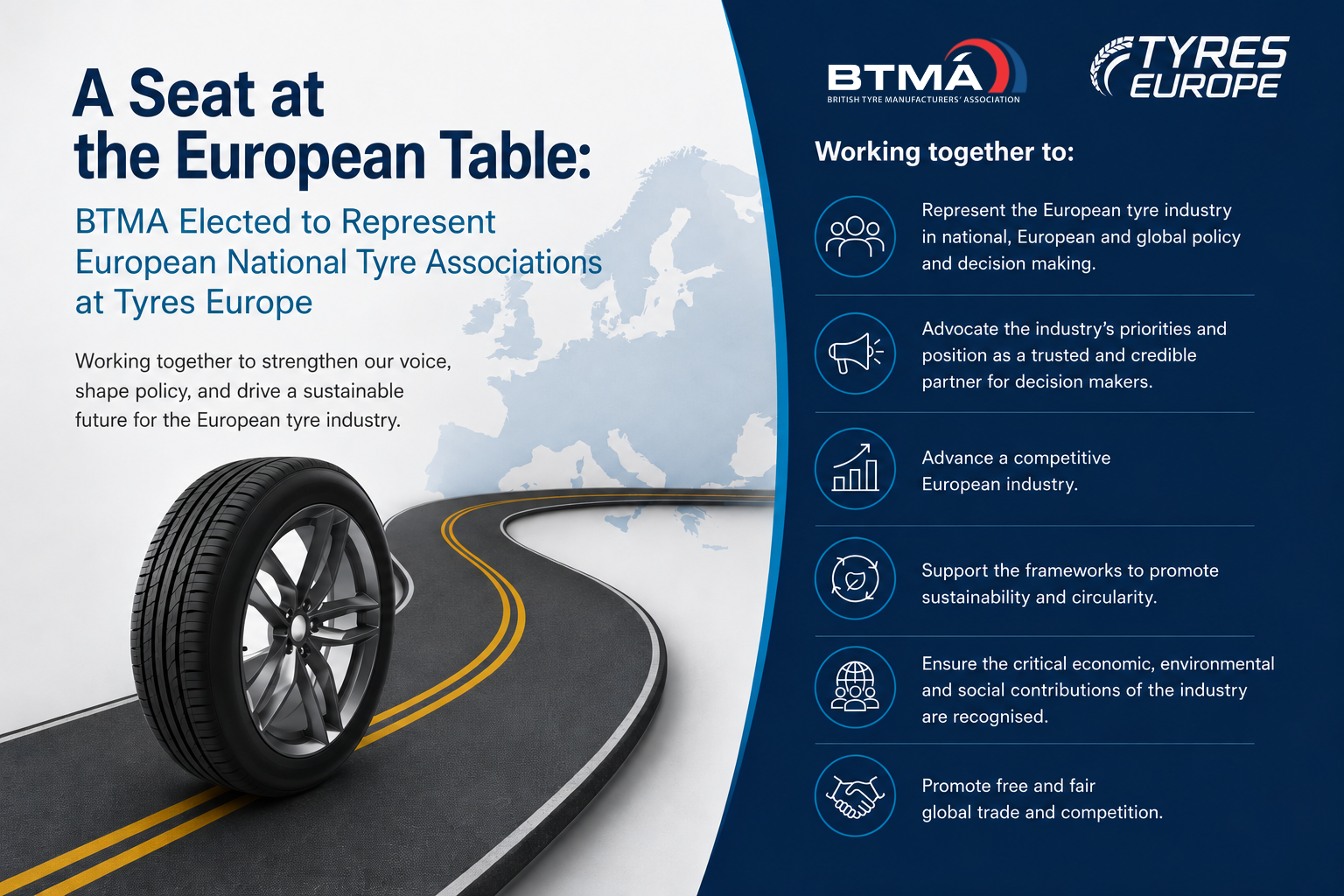
BTMA NEWSLETTER | EUROPEAN AFFAIRS Tyres Europe has established a National Associations Leadership Council, giving…

BTMA: UK tyre market rebounds, but structural challenges remain
The British Tyre Manufacturers’ Association (BTMA) is warning that, while the UK tyre market has made a strong start to 2026, the industry continues to face significant structural challenges.
In an in-depth interview with Tyre Trends, BTMA Chief Executive Darren Lindsey highlights a sharp recovery in replacement tyre demand during the first half of the year. Car tyre volumes increased by 24%, SUV fitments by 31% and light truck tyres by 44%, putting the combined consumer segment 27% above the same period in 2025.
However, Lindsey cautions that the recovery should not obscure the longer-term pressures facing UK tyre manufacturers. These include low-cost imports, high UK energy costs, declining domestic manufacturing capacity and challenges around end-of-life tyre management.
The EV effect
The growing number of electric vehicles entering their first replacement cycle is providing another important source of demand. Lindsey notes that around one in four new vehicles sold in the UK is now fully electric, with many of the vehicles sold three years ago beginning to require replacement tyres. Premium manufacturers are also benefiting from EV owners often replacing tyres with the same homologated products originally fitted to their vehicles.
A changing market
Lindsey describes the UK tyre market as increasingly resembling an “hourglass”: premium brands remain comparatively resilient, while low-cost imported tyres continue to gain market share. Mid-tier brands are being squeezed between the two.
The BTMA is also calling for stronger market surveillance and fair competition, arguing that imported tyres must meet the same safety, durability and performance standards expected of established manufacturers.
Circularity and the future of tyres
One of the most significant issues raised is the UK’s approach to end-of-life tyres. Lindsey highlights concerns over the traceability of exported waste tyres and argues that more value should be retained in the UK through retreading, remanufacturing and a stronger circular economy.
The BTMA estimates that only one in four truck tyres in Britain is now remanufactured, compared with around one in two a decade ago. The association believes there is an opportunity to reverse this decline through better policy, procurement and greater awareness of the economic and environmental benefits of remanufacturing.
Looking ahead, Lindsey believes the tyre industry will increasingly become part of a wider mobility ecosystem, shaped by electrification, automation, connected vehicles and changing patterns of vehicle ownership. For tyre manufacturers, this will create demand for increasingly intelligent and connected products capable of delivering reliable performance in more demanding applications.
Related Posts