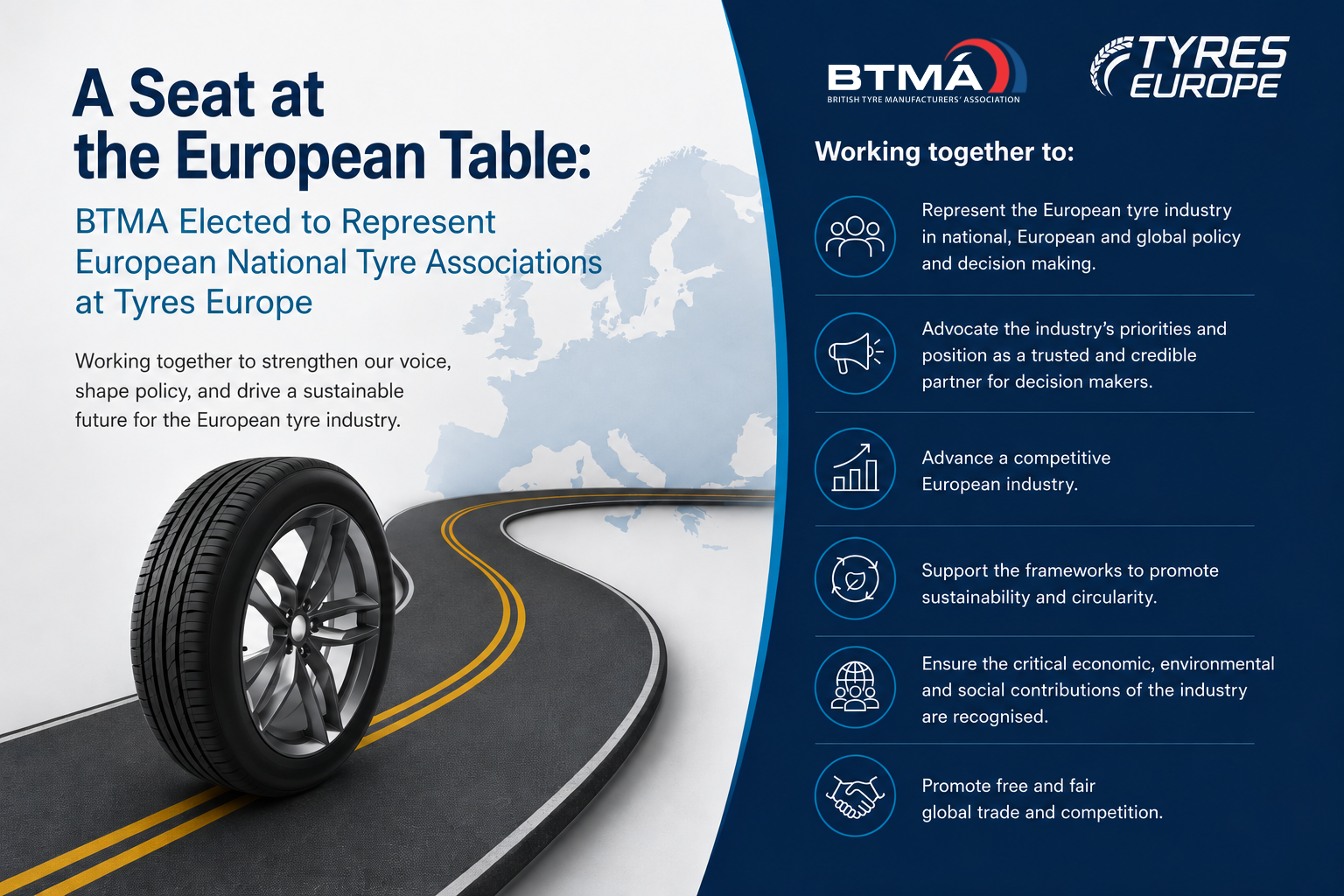
BTMA NEWSLETTER | EUROPEAN AFFAIRS Tyres Europe has established a National Associations Leadership Council, giving…

BTMA calls for urgent reset on retread messaging as industry faces “critical crossroads”
Darren Lindsey to challenge industry and government at The Tire Cologne
The British Tyre Manufacturers’ Association (BTMA) is using one of Europe’s largest tyre industry platforms to issue a stark warning to the retread sector: without stronger communication, clearer policy support and greater industry coordination, retreading risks losing relevance despite growing sustainability demands.
Speaking at The Tire Cologne during a panel discussion exploring “The Challenges of Promoting Retreads to Fleets and Governments”, BTMA Chief Executive Darren Lindsey will argue that the sector’s biggest challenge is no longer technical capability—but communication.
His message is clear: retreading has not lost the argument; it has failed to make it.
Despite increasing focus on sustainability, circular economy principles and carbon reduction across transport and logistics, retread adoption continues to face barriers—particularly among medium and smaller fleets.
According to Lindsey, this is not a failure of performance but of perception.
“Retreading isn’t losing ground – it never fully occupied it,” said Darren Lindsey, Chief Executive of the BTMA.
“The uncomfortable truth is that our industry has historically communicated like a supply chain rather than a movement. We have spent years proving retreads are technically safe and sustainable, but too often we have failed to communicate that message with confidence, consistency and urgency.”
The discussion comes at a pivotal time for the sector.
While large fleet operators generally understand the operational and cost benefits of retreading, BTMA believes smaller operators remain harder to engage—not because they oppose retreads, but because they face practical barriers around time, risk and operational simplicity.
Lindsey argues that many SMEs are making rational decisions in complex operating environments.
“Smaller fleets are not resistant to retreading—they are often under-resourced, time-poor and understandably risk averse.
“If adopting retreading requires lengthy explanation or operational complexity, then we have already lost part of that market.”
The BTMA will also use the discussion to challenge governments to move beyond sustainability rhetoric and embed circular economy principles more directly into fleet procurement policy.
While public sector organisations increasingly commit to net zero and resource efficiency targets, procurement frameworks often remain focused on lowest upfront cost rather than whole-life environmental performance.
BTMA believes this approach must evolve.
“Sustainability alone will not secure the future of retreading,” Lindsey said.
“We need procurement systems that recognise lifecycle value, carbon savings and resource efficiency—not simply lowest purchase price.”
The association is calling for stronger policy mechanisms to support retreading, including:
- Greater recognition of retreads within sustainable procurement frameworks
• Carbon-based assessment criteria in fleet purchasing
• Consideration of minimum retread utilisation targets within public sector fleets
• Stronger alignment between circular economy objectives and transport procurement
The BTMA will also address the growing challenge of misinformation and poorly contextualised reporting surrounding tyre sustainability.
Recent media coverage linked to overseas research on tyre-derived microplastics has highlighted what Lindsey describes as the need for faster, more coordinated industry responses to emerging claims.
“The challenge is not simply bad science—it is slow response,” he said.
“If misinformation is not challenged quickly and confidently, it risks shaping public understanding before the facts are properly understood.”
Alongside government engagement, the BTMA is expected to call for greater coordination across Europe, warning that fragmented messaging and inconsistent standards continue to weaken the sector’s competitiveness against globally coordinated new tyre markets.
The Tire Cologne panel provides an important opportunity for industry leaders to examine how retreading can better position itself within the future transport and sustainability agenda.
For BTMA, the conversation is increasingly urgent.
“Retreading sits at the intersection of sustainability, resource efficiency and transport resilience,” Lindsey said.
“But without stronger communication and coordinated action, the sector risks missing an opportunity it is uniquely placed to lead.”
Related Posts