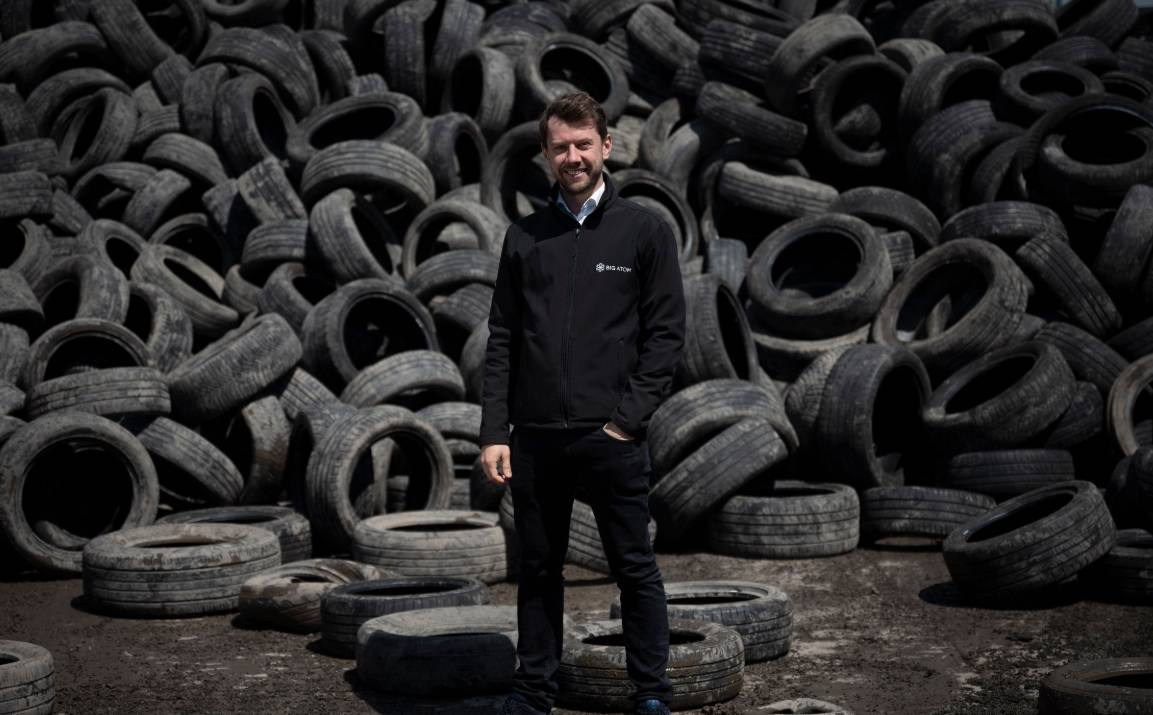
Darren Lindsey to challenge industry and government at The Tire Cologne The British Tyre Manufacturers’…
Digital Waste Tracking: What October 2026 Means for the UK Tyre Industry
Published: 1st April 2026 Further information: DEFRA link
1. Digital Waste Tracking: What October 2026 Means for the UK Tyre Industry
From October 2026, digital waste tracking will become mandatory for waste receiving sites across the UK. For the tyre industry, this marks one of the most significant regulatory shifts in decades not simply replacing paper with pixels but fundamentally changing how end-of-life tyres (ELTs) are documented, traced and regulated.
At the British Tyre Manufacturers’ Association (BTMA), we have long argued that you cannot regulate what you cannot see. Digital Waste Tracking (DWT) promises, at last, to provide that visibility but the transition will not be without challenges.
2. Why digital waste tracking matters for tyres
Today’s Waste Transfer Note (WTN) system was never designed for complex, multi-stage recovery chains like tyres. Each movement generates a separate paper record, with no requirement to link one transfer to the next. By the time a tyre reaches its final fate, a trail of unconnected paperwork exists compliant on paper, but opaque in practice.
For tyres, this creates well-understood problems:
- Collections are typically recorded by number of tyres, while recycling and recovery are recorded by weight.
- Quantities declared by the waste holder often differ from what is
- Quarter-year reporting to the Environment Agency relies on weight conversions based on historic averages.
- Final weighbridge data may only surface much later, creating discrepancies during
- Digital Waste Tracking is intended to address these weaknesses by creating a single digital dossier that follows a waste consignment from arising to ultimate In principle, quarterly reporting and export documentation (such as Annex VII) would flow directly from the same underlying dataset.
- Intellectually, the idea is Practically, tyres expose the hardest edge of implementation.
3. What becomes mandatory from October 2026
From October 2026, waste receiving sites will be the first actors brought into scope. This includes tyre recyclers, processors, retreaders receiving casings, pyrolysis and material-recovery facilities, and any transfer station accepting ELTs.
These sites will be required to:
- Digitally record every load of waste tyres received
- Confirm waste descriptions, quantities and origin
- Submit receipt data into the national DWT service in near real time
For the first time, regulators will have direct visibility of what arrives at recovery sites not months later during inspections, but as movements occur.
4. Traceability: from aspiration to expectation
For a sector that has faced years of scrutiny over mis-classification, paper compliance and unverifiable onward movements, digital traceability is transformative.
Each movement of waste tyres will carry:
- A unique digital reference
- An identified producer, carrier and receiving site
- A declared waste code
- A confirmed digital receipt
Crucially, this creates an evidence-based chain of custody that strengthens legitimate operators while exposing gaps, inconsistencies and implausible recovery claims.
This will be especially important for exports. Digital records linking domestic movements to shipment documentation will significantly improve the Environment Agency’s ability to assess whether tyres genuinely reach environmentally sound recovery destinations.
5. The awkward reality: numbers, weights and conversions
The tyre industry has long lived with an uncomfortable truth: upstream transactions count tyres, downstream processes weigh them. Under DWT, this tension becomes unavoidable.
Industry experience shows that:
- Collectors often estimate weight using historic average tyre weights
- Actual weights are only established when loads reach a weighbridge
- Differences between declared and actual tonnage are common
- Digital Waste Tracking does not make this problem disappear, but it makes it
To function effectively for tyres, the system must allow:
- Provisional quantity declarations to be corrected within a defined window
- Conversion from number-based inputs to weight using variable, not fixed, factors
- Subsequent correction of averages using actual weighbridge data Without this flexibility, compliance friction simply shifts location rather than
6. Individual tracking: attractive, but premature
One recurring question is whether tyres should be tracked individually rather than by consignment. In theory, individual tracking could:
- Improve proof of compliance for tyres destined for re-use
- Strengthen end-of-waste claims for casings intended for retreading
In practice, this would require machine-readable identification such as RFID on every tyre. While some manufacturers (particularly in the truck sector) already use RFID, and countries like France require labelling for certain ELT categories, universal coverage remains a long way off.
Manually labelling tens of millions of tyres each year would be disproportionate and impractical. For the foreseeable future, most ELTs will need to enter the DWT system by consignment, with the option to split sub-streams later where individual compliance is genuinely needed.
7. Part-worns, reuse and grey areas
Digital tracking also brings long-standing grey areas into the spotlight particularly the handling of part-worn tyres.
Third-party operators sorting part-worns on collectors’ sites have historically sat below the radar of WTNs,
often on the assumption that tyres selected for reuse are no longer waste. Under DWT, mismatches between ELTs received and waste dispatched become immediately visible unless properly accounted for.
If Digital Waste Tracking is to support rather than undermine legitimate reuse and retreading, it must:
- Allow consignments to be split mid-journey
- Clearly distinguish waste from confirmed end-of-waste outputs
- Avoid creating loopholes that incentivise informal or undocumented activity
8. A foundation, not a silver bullet
Digital Waste Tracking will not, on its own, solve every challenge facing ELT management. But it does provide something the tyre industry has never had before: a reliable, national data backbone.
That backbone will be essential for:
- Credible mass-balance data
- Fair and enforceable Extended Producer Responsibility (EPR)
- Investment confidence in UK recovery capacity
- A genuinely circular tyre economy
As October 2026 approaches, preparation will matter. Businesses that engage early with data quality, system readiness and internal processes will find DWT reduces uncertainty. Those that do not may find it removes excuses.
For BTMA members, the message is clear: Digital Waste Tracking is not just another compliance requirement. It is a structural reform that will reshape how responsibility, accountability and sustainability are demonstrated across the UK tyre industry.
Related Posts