The British Tyre Manufacturers’ Association (BTMA) has written to the Secretary of State for the…
Building a Circular Future for Tyres: Inside Big Atom’s Mission to Transform Resource Recovery
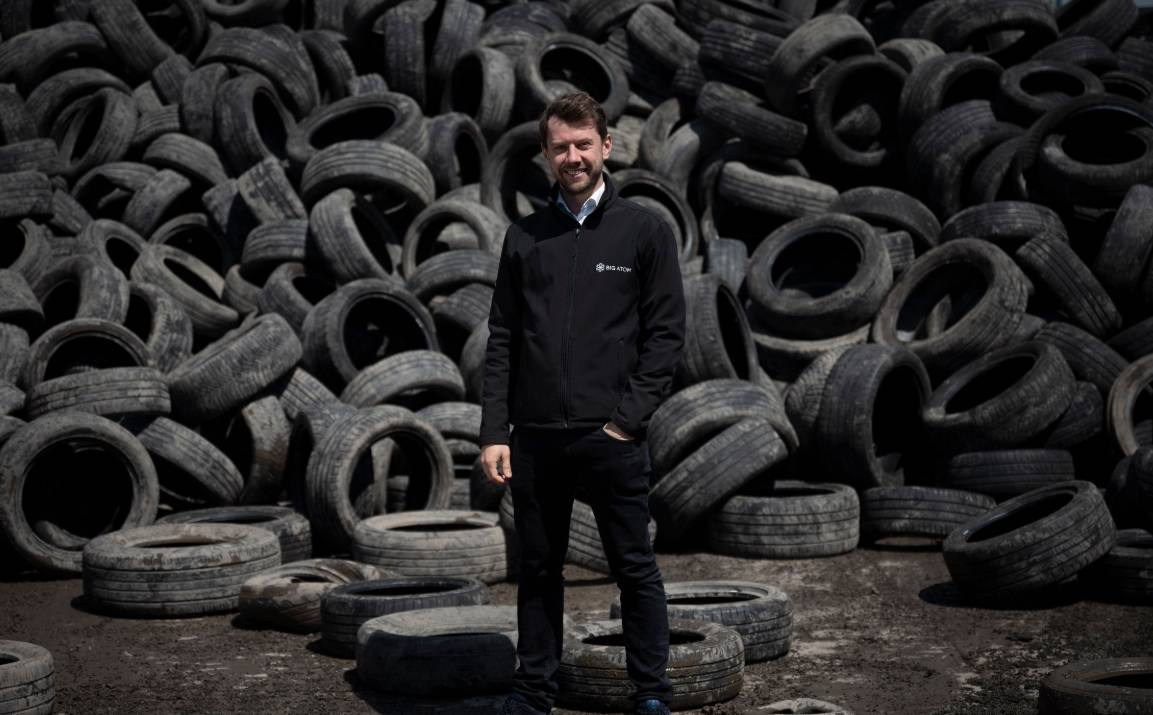
When Big Atom launched in 2017, its founding belief was disarmingly simple: resources should never go to waste. Eight years later, that mission has evolved into one of the most ambitious circular-economy projects in the UK. We sat down with Alexander Guslisty, CEO of Big Atom, to discuss how the company is reshaping tyre recycling, what it will take to unlock advanced recycling at scale, and why the future of the industry depends on better collaboration across the value chain.
From Problem Waste to Resource Opportunity
For Alexander, the story began not with tyres, but with polymers.
“I’ve always found it absurd that we spend huge amounts of money and energy extracting materials from the ground, turning them into high-performance products, and then at end of life we either burn them or downcycle them into something low-value.” he explains.
As a chemical engineer, he was fascinated by the potential of pyrolysis—a process that can break down end-of-life polymers into reusable oil. Tyres stood out as a uniquely consistent waste stream: engineered, homogeneous and rich in hydrocarbons.
Yet the UK tyre recycling landscape he encountered was almost entirely linear. Collections were largely paper-based, dominated by fragmented operators and heavily dependent on TDF (tyre-derived fuel) or export. Traceability was minimal. Circularity, as he puts it, “simply wasn’t part of the system.”
Big Atom set out to change that—first by building end-to-end tyre operations themselves: collections, shredding, granulation and pilot-scale pyrolysis. “In hindsight we took on too much for a start-up,” Alexander admits, “but it gave us a deep understanding of the entire value chain, and that’s shaped everything we do now.”
Reframing the Challenge: The Real Bottleneck Isn’t Technology
Many assume the barrier to advanced recycling is technological. But Alexander disagrees.
“There’s a lot of good pyrolysis technology already developed—some sitting in companies that never moved past pilot scale. The problem isn’t the tech. It’s the ecosystem around it.”
He describes the circular model as two semicircles:
- The supply chain – highly developed.
- The recovery chain – fragmented, under-invested and lacking contractual certainty.
Without reliable feedstock, consistent routing, and bankable offtake agreements, commercial pyrolysis plants struggle to secure the £50–100m required to build.
Big Atom realised they didn’t need to build every plant themselves. They needed to build the infrastructure that allows many plants to succeed.
That led to the company’s pivot from recycler to platform operator—a digital and contractual backbone designed to organise the recovery chain and unlock the investment needed for advanced recycling.
How Pyrolysis Works—And Why It Matters
Pyrolysis heats shredded tyre rubber without oxygen, breaking long hydrocarbon chains into three valuable outputs:
- Tyre pyrolysis oil (TPO) – a chemically useful recycled oil
- Gas – used to power the process
- Recovered carbon black (rCB) – a substitute for virgin carbon black
This is powerful because it creates a true circular loop:
tyres → oil → rubber → tyres again
Instead of downcycling tyres into low-grade applications, pyrolysis recovers raw materials capable of re-entering tyre manufacturing or other high-value sectors.
But scaling pyrolysis requires more than technology—it requires an organised market.
A Digital Platform for a Circular Tyre System
Big Atom’s platform links manufacturers, collectors, processors and recyclers through a system of recycling vouchers and digital tracking.
Here’s how it works:
- Manufacturers purchase vouchers for every tyre they put on the market.
- Each voucher sponsors the recycling of an end-of-life tyre and allows the manufacturer to choose the recycling route (e.g., pyrolysis).
- The platform tracks the tyre’s journey digitally, from collection to processing.
- Volumes are aggregated into bankable contracts that support investment in advanced recycling plants.
This creates the missing mechanism that ties supply, recovery and demand together.
Alexander uses an analogy:
“Think of Uber for taxi drivers. Uber didn’t invent cars or roads – it created an ecosystem that makes it dramatically easier to monetise your car and your time, and to access the tools you need. We’re trying to do the equivalent for tyre recycling technologies and stakeholders in tyre industry – and that, in my view, is what will get us to circularity at scale.”
Collaboration Across the Value Chain: The Key to Unlocking Circularity
According to Alexander, every part of the tyre value chain wants to improve sustainability—but stakeholders are still optimising for themselves rather than the whole.
Manufacturers want recycled inputs.
Recyclers want stable volumes.
Investors want certainty.
Government wants compliance.
The missing link is a coordinated system.
Big Atom’s vouchers give manufacturers a direct role in shaping recycling outcomes and create the long-term commitments needed to finance UK pyrolysis plants. Their digital layer provides the visibility and auditability the industry has lacked.
But Alexander stresses policy also has a role to play—particularly in setting clear long-term goals, levelling the regulatory playing field, and supporting domestic processing where it makes sense.
Carbon Savings: Not Just a Future Benefit
While large-scale pyrolysis is still developing in the UK, Big Atom already delivers measurable impact.
- 150 tonnes of CO₂ saved per 1 million tyres by reducing transport distances through organised routing.
- ~30,000 tonnes of CO₂ avoided per 1 million tyres by diverting material away from incineration.
Once commercial pyrolysis plants are running, the carbon savings multiply—through displacement of virgin oil and virgin carbon black.
What It Will Take to Win: Scaling, Simplicity and Access
For Alexander, three conditions are essential for a truly circular system:
- Manufacturers must have a simple, low-friction way to sponsor recovery at scale.
- All stakeholders need to operate on shared digital rails—common contracts, data and outcomes.
- Innovators must have access to waste streams, otherwise new technologies cannot emerge.
If those conditions are met, he says, recovering resources from waste will become more efficient than extracting them from the earth.
The UK’s Role in a Global Circular Economy
Alexander does not believe the UK will—or should—try to do all tyre recycling onshore. Instead, he sees the UK as a testbed for how the full recovery chain should function:
- Traceable and organised feedstock
- Local first-step processing
- A mix of domestic and overseas advanced recycling
- Digital tracking and mass-balance accounting
- Clear standards for rCB and TPO
Get that right, and the model can be exported globally.
What Success Looks Like in 5–10 Years
For Big Atom:
- Recycling vouchers become standard practice for every tyre sold.
- Manufacturers regularly receive recycled materials in proportion to what they sponsor.
- The platform supports every serious pyrolysis plant in Europe, and eventually the Americas.
For the industry:
- A recovery chain that is organised, transparent and financeable.
- Pyrolysis plants operating at commercial scale with bankable feedstock.
- Recycled materials—rCB, TPO, secondary rubber products—becoming routine inputs in manufacturing.
- A clear, traceable link between what manufacturers sell and what they recover.
“The more you put on the market, the more you should contribute—and the more recycled material you should get back,” Alexander says. “That’s what a real circular economy looks like.”
Big Atom’s work highlights an important truth: the future of tyre recycling hinges less on a single technology and more on building the system around it.
By organising feedstock, enabling collaboration, and making recycling choices visible and contractual, Big Atom is laying the foundations for the UK’s first scalable circular tyre economy—and setting a blueprint that could influence tyre recovery far beyond the UK’s borders.
Related Posts